
Copyright © Datachain, Inc. All rights reserved.

Enterprise Wallet for On-chain Finance
On-chain finance, secured for enterprise operations.
The industry's first* enterprise-grade Web3 wallet integrating Passkey and on-chain privacy.
Early access now available
*First to combine Passkey and privacy protection in an enterprise Web3 wallet (as of March 2026, based on our own research)
What is Datachain Wallet
A wallet built for enterprise operations
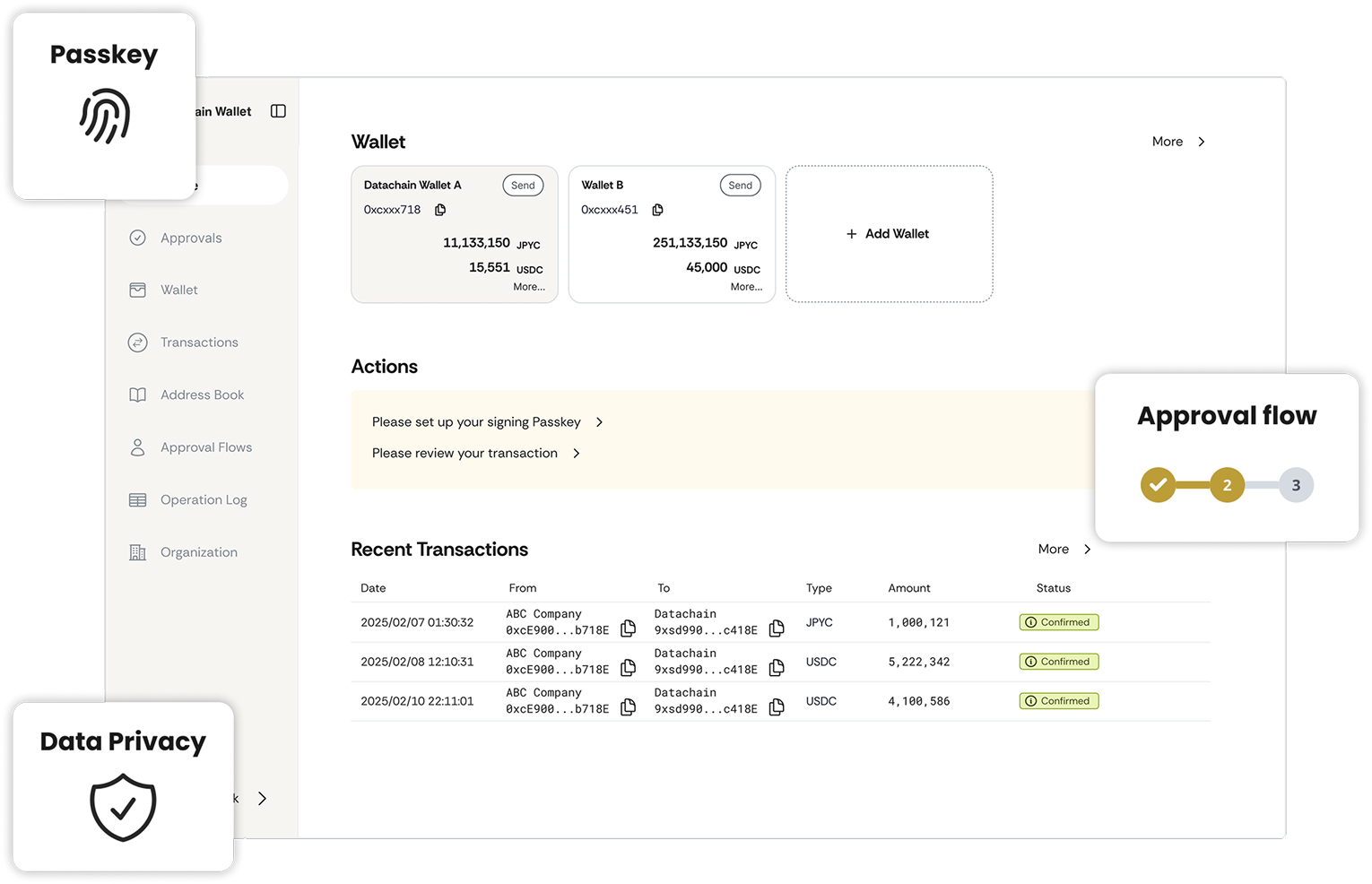
Datachain Wallet is a fully in-house developed, Japan-made enterprise Web3 wallet that lets businesses securely manage digital assets such as stablecoins and tokenized deposits.
It solves challenges consumer wallets struggle with — key management, approval workflows, gas fee operations, and on-chain privacy — delivering the controls and usability enterprises require.
It solves challenges consumer wallets struggle with — key management, approval workflows, gas fee operations, and on-chain privacy — delivering the controls and usability enterprises require.
Using stablecoins in business
takes more than a wallet
Stablecoins and tokenized deposits offer significant advantages in transfer cost and lead time. But when you try to run them as part of real business operations, you hit challenges that consumer wallets were never designed for.
01
Private keys depend on a single individual
When a specific employee holds the private key or seed phrase, loss, resignation, or unauthorized access leads directly to loss of assets. Key management that depends on an individual is not an organizational control framework.
02
Withdrawals are approved over chat or verbally
Transfers are executed with no record of who approved what, and when. When an audit firm or internal audit asks you to prove your approval process, there is no evidence to present.
03
Holding crypto for gas fees is a burden
The fee tokens such as ETH required for every transfer are all subject to accounting and internal control — procurement, holding, replenishment, and revaluation. A single task like a transfer ends up requiring a separate management framework.
04
Counterparties, amounts, and balances are all public
Transactions on the blockchain can be viewed by anyone. From the composition of counterparties, transfer amounts, balances, and fund-movement history, third parties can infer your purchase prices and financial capacity — a risk that never existed with traditional bank transfers.
05
Overseas services are hard to align with domestic requirements
Even when you request specification changes to match domestic accounting and audit practices or regulatory requirements, priorities or development capacity can make them difficult. Inquiries in Japanese and case-by-case customization are also constrained.
Seven capabilities essential for enterprise use
From security and internal controls to operational support and privacy, we support enterprise management of on-chain assets.
1
Safer, simpler key management with Passkey
Passkey support reduces the burden of private key management, balancing security and ease of use, with easy recovery even when a device is changed or lost.
2
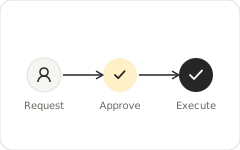
Approval controls that meet organizational requirements
Request-approval workflows, permission management, and multisig enable wallet operation aligned with your organization's governance rules.
3
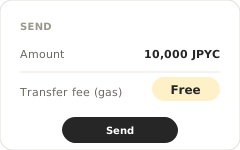
No need to manage crypto for fees (gasless)
No need to hold, top up, or manage fee tokens such as ETH. Execute stablecoin transfers without adding to your accounting, operational, or internal-control burden.
4
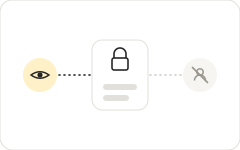
Protect on-chain transaction data
With "KuraPrivacy," protect on-chain data such as counterparties, amounts, balances, and fund history, while selectively disclosing what audits and counterparty verification require.
5
Export the history audits require, as-is
We record the operator and timestamp for each request, approval, and signing operation. You can output the history needed for submission to audit firms or internal audit, reducing the accounting and audit burden.
6
From embedding in your own service to SaaS use
We support both embedding into your own service via API/SDK and use as a SaaS. From offering wallet features as part of your own product to internal business use, you can choose the model that fits your business.
7
In-house development tuned to domestic practice
Datachain develops in-house in Japan. We prioritize support for stablecoins and services issued and circulated domestically, and can also discuss development tailored to your business processes and accounting and compliance requirements.
The rules of control live on the blockchain
Enterprise wallets fall broadly into contract wallets (multisig) and MPC wallets. The difference lies not only in how keys are held, but also in where the rule of "who approved it" is executed.
With an MPC wallet, the approval rules are evaluated on the operator's server. The split shares produce a single signature, and the blockchain only checks whether that signature is valid before executing the transaction. The approval requirements themselves are not verified on-chain, and there is no record of who approved.
Datachain Wallet, by contrast, is a contract wallet. Multiple independent keys each sign, and those signatures are passed to the chain as-is. The signer configuration and the approval requirements needed to execute a transaction are recorded on-chain, and the contract itself verifies and executes them — so this can be verified directly by third parties, without going through our systems.
On top of that, we've absorbed into the product the burdens that traditional contract wallets have placed on enterprises — seed phrase management, holding crypto for gas, and running request-approval operations.
Where the approval rules are executed
Contract wallet
On-chain control
Request
Multiple independent keys
Key AKey BKey C
Each signs individually
Multiple signatures
Blockchain
Approval rules executedThe contract verifies the multi-signature requirementTransactions that don't meet it aren't executed
Transaction executedAll signers are recorded
MPC wallet
Off-chain control
Request
Approval rules executedon the operator's server
MPC shares: one key split
Share AShare BShare C
Each approver approves; aggregated into one signature
1 signature
Blockchain
Single-signature checkOnly checks whether the signature is validApproval requirements are not verified
Transaction executedNo record of individual approvers
Item-by-item comparison
| Datachain Wallet | Typical contract wallet | MPC wallet | |
|---|---|---|---|
| Wallet structure | Smart contract wallet | Smart contract wallet | EOA wallet |
| How signing authority is distributed | MultisigAuthority distributed across multiple independent signing keys | MultisigAuthority distributed across multiple independent signing keys | MPCA single signing authority split into multiple MPC shares |
| Signing & key management | Uses PasskeySign via face or fingerprint from the browser on any device where the Passkey is registered and synced | Typically uses external consumer or hardware wallets as signers | MPC shares stored in a distributed mannerSigning uses mobile apps, dedicated devices, API signing environments, etc. |
| Seed phrase management | Not requiredNo operational risk of loss, leakage, or handover | RequiredEach signer must define storage and handover procedures | Not required |
| Device change / addition / loss | Uses Passkey sync to support multiple devices and device changes | Depends on each signer's own external-wallet recovery method | Uses the service's prescribed recovery — reconstructing MPC shares, backup, adding devices, etc. |
| Managing approval rules & signer config | On-chain"Who can sign" and "how many signatures are required" are recorded tamper-proof | On-chain | On the off-chain wallet operator's systemBoth the settings and their change history stay under the operator's control |
| Where approval rules are executed | The contract itselfTransactions that don't meet the requirements are rejected by the chain outright | The contract itself | The wallet operator's serverControl effectiveness depends on that system's uptime and correctness |
| On-chain signature visibility | All approver signatures are verifiable on-chain | All approver signatures are verifiable on-chain | Only a single signature is visible on-chain |
| Transfer fees (gas) | Fully gaslessNo procurement, holding, top-up, or revaluation of ETH, etc. | Generally requiredAccounting for holdings, plus monitoring to avoid running out | Some services offer gas-management features, but approaches vary by service |
| Audit & verification | Who holds signing authority and how many signatures are required can be verified independently on-chain | Who holds signing authority and how many signatures are required can be verified independently on-chain | On-chain, mainly the final generated signature is visible; internal approvers, approval paths, and policy details depend on the operator's system data |
| Dependence on the wallet operator | Assets and permissions are managed on-chain using standard blockchain technology, keeping dependence on Datachain low | Assets and permissions are managed on-chain using standard blockchain technology, keeping dependence on a specific operator low | MPC protocol, share management, and signing infrastructure can be vendor-specific, tending toward higher operator dependence |
| If the operator stops the service | Assets and signing authority remain on-chain and are unaffected | Not affected | Highly dependent on the operator's system; whether and how recovery is possible depends on each company's rules |
| Migration to quantum resistance | Easy to migrate to future quantum-resistant signature schemes via smart-contract extension | Can be extended to future quantum-resistant signature schemes | Current MPC-TSS centers on ECDSA / EdDSA; migration requires the wallet operator's MPC protocol to support it |
Use cases
We support enterprise on-chain finance with stablecoins — corporate treasury, B2B payments, and merchant payments.
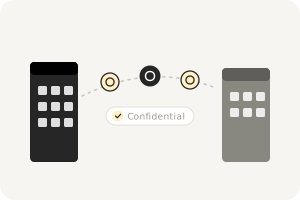
Business-to-business payments
Supports stablecoin payments with counterparties, partners, and group companies. Approval workflows and gasless support fit transfers and receipts to your operational flow.
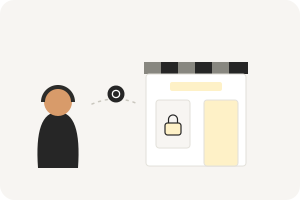
Receiving payments in retail and e-commerce
Supports stablecoin payments from consumers to businesses and stores. Gasless operation and permission management let retailers and e-commerce operators receive funds with confidence.
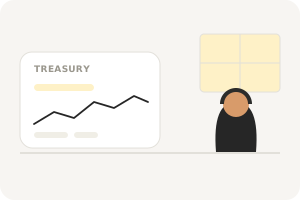
Manage corporate assets organizationally and securely
Supports holding, transferring, and managing stablecoins and on-chain assets. Permission management and approval flows keep corporate assets secure.
How to start with the early access version
The early access version is free of charge. You can start using it in as little as one week from your first inquiry.
STEP 02
Consultation
Our representative will ask about your anticipated use cases and the assets and chains involved. You can also see a demonstration at this stage.
STEP 03
Sign the usage application
After confirming the terms of use, you fill in and sign the application form. Electronic signatures are supported, so no mailing of documents is required.
STEP 04
Start using
We handle your organization's initial setup, signer registration, and guidance on operating procedures. Once setup is complete, you can start using the early access version.
Security and business foundations
for confident use
Datachain is a group company of Speee, Inc. (TSE Standard, code: 4499). Through ISMS certification and a SOC 2 report, we maintain an information security framework enterprises and financial institutions can trust. We also advance real-world on-chain finance through work in stablecoins, tokenized deposits, cross-chain, and on-chain privacy.
Certification No.: JQA-IM1686
Scope of Registration:Planning, development, operation,
and provision of software and services related to
the Datachain Wallet Web3 wallet.
Scope of Registration:Planning, development, operation,
and provision of software and services related to
the Datachain Wallet Web3 wallet.
Service Covered:Datachain Wallet
Assessment Criteria:Security
Assessment Criteria:Security

We are a subsidiary of Speee, Inc.
(TSE listed, securities code: 4499)
(TSE listed, securities code: 4499)
Frequently asked questions
Is it custodial or non-custodial?
Datachain Wallet is a non-custodial wallet. To move assets, a signature from a user with the necessary permissions is required, based on the approval workflow you configure. Datachain cannot hold your private key or move your assets on its own.
What is a Passkey?
A Passkey is a mechanism that uses your device's face recognition, fingerprint, or PIN — instead of a password or seed phrase — to verify identity and sign. Datachain Wallet uses Passkeys to sign important operations such as transfers. No secret information needs to be memorized or entered, which reduces the risk of losing or leaking a seed phrase. The biometric data itself is never sent to or stored by Datachain.
If I lose or change the device where my Passkey is registered, will I lose access to my assets?
By using sync features such as iCloud Keychain, Google Password Manager, or 1Password, you can use your Passkey on another device logged into the same account, or on a device after a model change. In addition, based on your organization's approval procedures, you can revoke the permissions of a signer using a lost device and register a new signer or Passkey.
Where is the private key stored?
The private key used for signing is stored encrypted in Passkey management infrastructure, including FIDO2-compliant password managers such as iCloud Keychain, Google Password Manager, and 1Password. Your private key and biometric data are never stored on Datachain's servers. By using the same Apple Account or Google account, you can sync your Passkey across multiple devices. The Passkey's private key also cannot be exported by the user as a file or string, or otherwise taken outside — reducing the risk of copying, exfiltration, misdelivery, or leakage of the key.
What happens to my assets if the service ends?
Even if the Datachain Wallet service ends, your on-chain assets will not be transferred to, or become the property of, Datachain. If we discontinue the service, we will notify you in advance and guide you through the migration steps needed to move assets to another wallet or to change signers and management methods. The specific method varies depending on the chain, wallet configuration, and contract terms you use.
Which chains and assets are supported?
In the early access version, we support Ethereum, Polygon, Avalanche, and Base, and you can use JPYC, USDC, and USDT. We plan to progressively expand coverage, focusing on EVM-compatible chains and major domestic and international stablecoins and crypto assets.
Do you support audit logs and CSV export?
We record operation history such as requests, approvals, signatures, and transaction execution, together with the operator, timestamp, and target transaction. The recorded history can be output in CSV format for use in internal audits or evidence submission to audit firms. The required record items and submission format can be discussed at the time of adoption.
Is integration via API and SDK possible?
Yes. In addition to the SaaS format that uses an admin console, you can embed wallet functionality into the existing apps and services of financial institutions, payment services, and operating companies via API and SDK. Individual customization to your authentication method, approval flow, screen composition, and accounting and compliance requirements can also be discussed.
To whom, and to what extent, can protected information be disclosed?
You can selectively disclose only the necessary transaction information to pre-designated parties such as audit firms, regulators, counterparties, and internal audit departments. The disclosure target and scope can be set according to purpose, and you can grant view permissions to check balances or transaction details without handing over the authority to move assets. Note that the on-chain privacy protection feature is not offered in the current early access version and is planned for the full version.
What's the difference between the early access version and the full version?
The early access version is an evaluation release for verifying use cases and operational requirements in real enterprise operations ahead of the full version's launch, and for reflecting the feedback obtained into feature improvements for the full version. Until the full version launches, you can use the features currently provided in the early access version free of charge. However, the on-chain privacy protection feature is not yet available, and a cap may be placed on the amount of assets that can be managed within the wallet. We aim to launch the full version within 2026, expanding features, supported chains and assets, and our operations and support framework. The pricing model for the full version will be announced separately before launch.
Make enterprise stablecoin use
secure and simple.
For materials, feature details, or questions about adoption, please feel free to contact us.